
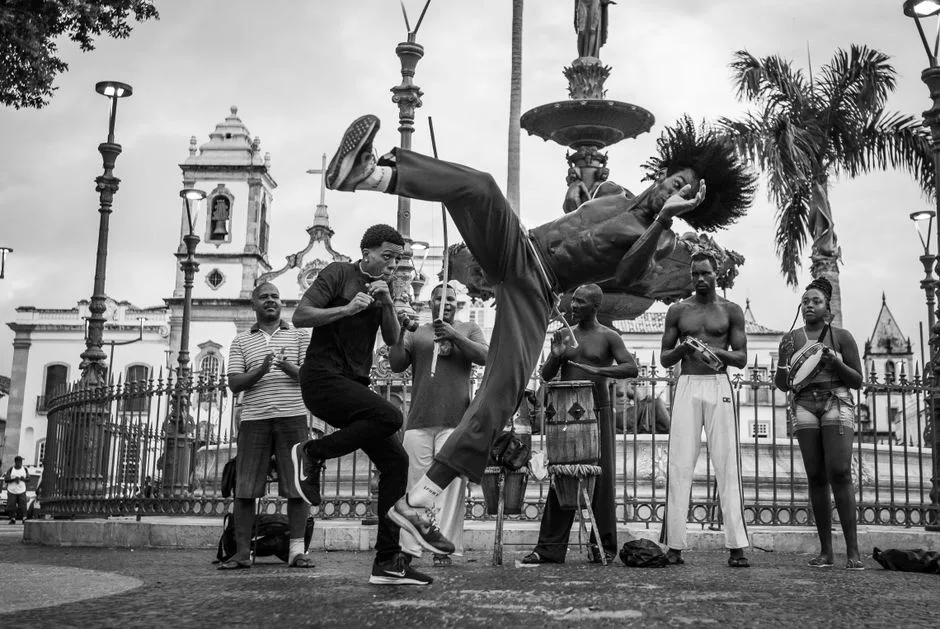
I was sweating under a low Pelourinho sun, barefoot on cobblestones, when a berimbau string twanged and three people—two locals and one startled-looking tourist—fell into a slow, smile-heavy roda. I hadn’t planned to stop; I had a list of museums to see. Instead I sat on a step and watched an hour stretch into one of those travel moments that won’t quit. That’s how most people I meet here discover capoeira: not by booking a class online but by watching one unfold, then asking if they can join.
Why learning capoeira in Brazil feels different
You can learn kicks and dodges anywhere, but capoeira in Brazil carries its own rhythm—the music is live, the songs are sung, and the space between movement and conversation is small. Teachers will correct your ginga not only to protect your ankle but to keep the roda’s music tight. You’ll be learning a martial art, a dance, and a social practice at once. That’s what makes tourist-friendly classes in Brazil worth the trip: you get the practice embedded in its cultural heartbeat, not a sterilized gym version.
Types of classes tourists usually find
There are three setups you’ll come across most often:
- Community classes at a local academy (a fixed space where a group meets weekly).
- Beach or public-space classes (informal, often early morning or late afternoon).
- Short workshops packaged for visitors—hostel activations or cultural centers offering one-off sessions.
Each format has trade-offs. Community classes will push your technique and language skills over time. Beach classes are social and gorgeous but weather-dependent. One-off workshops are obvious for tourists with limited time: you learn fundamentals and meet locals without committing to weekly attendance.
Where to go: city-by-city practical guide
I’ll name neighborhoods instead of a dozen random academies—those are easier to find and safer to rely on. In each city I’ve included how those classes usually run, what to bring, and how to find a drop-in session.
Salvador — Pelourinho, Barra, and the historic centers
Salvador is where capoeira’s visible, public identity is strongest. You’ll see rodas in Pelourinho squares and along the riverfront, and many cultural centers run regular classes aimed at visitors and locals alike. Classes in Salvador are often taught with strong musical emphasis: expect berimbau-led sequences and a lot of songs in Portuguese. Wear lightweight clothing—the humidity is real—and bring a small towel.
How to join: Walk the streets of Pelourinho and look for groups gathering near Largo do Pelourinho or Praça da Sé. Ask at your pousada or hotel for a recommended mestre or group; small local hostels tend to have ties with specific schools and can set up beginner visits. If you’re short on time, many academies post drop-in schedules on Instagram—search for the city name plus “capoeira”.
Rio de Janeiro — Ipanema, Lapa, and the hills
In Rio, classes happen in gyms, cultural centers, and on beaches. The classic tourist experience is a morning ginga session on Ipanema or Copacabana sand, followed by a walk and a coffee. Evenings in Lapa host rodas that blur into samba and nightlife. Teachers here tend to be used to foreigners and often adapt explanations into English or Spanglish. Bring sunscreen and an easy-to-remove shirt: you’ll want to cool off between rounds.
São Paulo — Vila Madalena, Centro, and parks
São Paulo’s capoeira scene is dispersed across neighborhoods and community centers. Vila Madalena has a creative, young vibe; classes in Centro or near Praça Roosevelt can be more traditional. Because the city is spread out, check transit times—what looks close on a map might be a long journey across traffic. Many São Paulo academies run evening classes for people who work during the day; drop-in visitors are usually welcome if you message ahead.
Recife and Olinda — Northeast rhythm and historical flavor
In Pernambuco, capoeira classes often overlap with other Afro-Brazilian and regional traditions: maracatu, frevo, and local percussion show up in the music. Olinda’s narrow streets host small rodas where the game is playful and local. If you have time, try to align with a workshop that explains how capoeira interacts with nearby cultural practices—the local teachers will show you how syncopation in the music dictates the game’s energy.
Florianópolis and coastal towns — beach classes and relaxed vibes
On the southern coast, capoeira often adopts a holiday tone: lots of beach classes, students mixing surf culture with martial art practice. If you’re staying in a beach town, ask your hotel reception about morning capoeira sessions—hosts and teachers often post on community boards. Classes here are usually casual and a great place to meet other travelers.
What a typical tourist class looks like
Forget the idea of marching into a new sport and leaving with perfect kicks. Most tourist classes are designed to be welcoming: they open with a warm-up that mixes basic jogging, stretching, and capoeira-specific movements, then move into the ginga (the foundational step). You’ll learn a few kicks and evasions, and the instructor will usually explain the instruments: berimbau, atabaque, pandeiro. If there’s time, there’s always a short roda where beginners take turns inside the circle with more experienced students guiding the flow.
Music, language, and the unexpected lesson
Music controls capoeira. The berimbau’s rhythm sets the game’s speed. Even if you don’t speak Portuguese, you’ll learn to listen: clapped rhythms and call-and-response singing cue when to move quick and when to slow down. Teachers often translate short phrases and explain song meanings, and you’ll pick up a handful of Portuguese terms—ginga, roda, mestre, aluno—just by repetition. Pay attention to those terms; they’re the grammar of the practice.
How to choose the right class
There are three practical filters I use when choosing where to train: style, accessibility, and community vibe.
- Style: Capoeira Angola is slower and strategic; Capoeira Regional or contemporânea can be faster and more acrobatic. Pick the tempo you enjoy.
- Accessibility: Look for clear drop-in policies and an instructor who speaks English if you need it.
- Community vibe: Watch a class first. If students laugh, keep eye contact, and help novices, you’ll feel welcome. If it’s rigid and closed to visitors, move on.
You don’t need to pick the “best” school—pick the one with the teacher you click with.
Questions to ask before you go
- Do you accept drop-ins, or do I need to register?
- Will someone speak English during class?
- What should I wear and bring?
- Is this class beginner-friendly?
Etiquette: how to behave in class and the roda
Capoeira is full of etiquette, most of it simple and respectful. Arrive on time, show attention when songs are taught, and avoid interrupting the roda. When you enter a roda, wait for an invitation or a teacher’s nod. During class, follow safety instructions—many movements involve partner timing, and mis-timed kicks hurt both people. If you want to film, always ask; some groups prefer that rodas remain private experiences.
What to wear and what to leave at home
Comfortable athletic wear is fine. In many academies you’ll be barefoot during the roda; bring thin socks if you’re sensitive to floor texture. Don’t wear jewelry that can snag or injure someone. Bring water and a small towel. Leave expensive gear and valuables in a safe place—across Brazil, cultural centers or studios may not have storage for guests.
Safety and health considerations
Capoeira is low-contact compared with some martial arts but high on momentum. If you have knee, lower-back, or shoulder issues, tell the instructor before class. Teachers usually offer modifications. Warm up thoroughly—capoeira relies on hip mobility and ankle stability. For outdoor classes, check the ground: sand is forgiving; cobblestones are not. If a class includes acrobatics, don’t attempt flips unless the coach explicitly teaches progressions and spots you.
How to find and book classes as a tourist
The internet makes this easier, but local networks still do it best. Here’s how I find classes faster than most travelers:
- Ask at hostels and small hotels—many have favorite local mestres.
- Search Instagram with the city name + “capoeira” and check recent posts for class photos or schedules.
- Walk districts known for culture—Pelourinho in Salvador, Lapa in Rio, Vila Madalena in São Paulo—and ask in bars or cafés; locals will point you to the nearest roda.
- Look for cultural centers (centros culturais) advertising workshops and open classes—these are often more visitor-friendly.
When you message a group, be clear about your level and language needs. A short photo or video of your movement isn’t required, but it helps teachers know how much to scale the class for you.
Costs, payments, and tipping
Many community classes accept a small donation or a drop-in fee—how much varies wildly by city and by venue. Some groups ask for cash; others use bank transfers or Pix. If a class is free, consider giving a modest donation or buying a CD or a T-shirt to support the group. If a mestre organizes a private session for you, expect a higher fee than a public class; the best approach is to ask the group’s preferred method of payment and follow local customs—bringing cash is often the easiest.
Language tips that make a difference
You don’t need fluent Portuguese, but a few phrases lubricate the experience. Learn “obrigado/obrigada” for thank-you, “bom dia/tarde/noite” for greetings, and “posso entrar?” to ask if you can join a roda. Use “desculpa” if you accidentally collide with someone. Teachers will usually translate key Portuguese terms, but your attempt at local phrases shows respect and gets you smiles.
Short stays: maximizing one or two classes
If you have only a day or two, prioritize a class that includes a roda and live music. The roda gives you the social context and the chance to play, even for a minute. Ask the teacher to explain one song’s meaning—that small cultural lesson will stick far longer than mastering a meia-lua de compasso. Bring a friend or partner if possible; it’s easier to get personal pointers when an instructor can focus on two people versus ten.
Longer stays: integrating into a local school
If you’re in Brazil for several weeks, commit to a community class and show up regularly. Capoeira rewards repetition and relationship. The more often you train, the more the group will include you in rodas, local events, and batizados (promotion ceremonies). Expect to pick up both movement and cultural cues naturally if you train consistently.
Finding a teacher who will mentor you
Mentorship grows from consistency. Start with a public class and, if you click with the style and the mestre, ask about regular classes. Teachers tend to welcome committed students—bring humility and a readiness to help set up mats or carry instruments. Those small contributions matter and build trust.
Workshops, festivals, and short intensives
Capoeira festivals and workshops pop up year-round in Brazil, often advertised on social media months ahead. Workshops offer concentrated learning: deep dives into music, Angola movements, acrobatics, or the history and songs. If you can time a trip to coincide with a local festival, you’ll see a diversity of styles and meet teachers from across the country. Otherwise, weekend intensives at cultural centers pack the same energy into a shorter timeframe.
Common misconceptions I correct for visitors
Visitors often expect capoeira to be either purely dance or purely fight. It’s both and neither—the art swings between play and threat depending on the music and the participants. Another misconception: capoeira is macho acrobatics. Many schools prioritize flow and musicality over impressive tricks. Lastly, people think you must be extremely fit to start. Not true. Capoeira builds mobility; it isn’t reserved for gym rats.
Stories from the mat: what real tourists experience
I once taught a visitor who insisted she was too clumsy to try. An hour later she’d managed a cautious meia-lua and was invited into a small roda. She left the city with a berimbau rhythm stuck in her head and a new travel friend’s phone number. Other tourists come back to Brazil to visit the same group months later. That’s the thing: capoeira is a social seed. Even brief classes can root friendships that keep growing long after your plane leaves.

What to expect after your first few classes
Physically, you’ll notice an increase in hip mobility, balance, and rhythm. Mentally, you’ll tune to group timing and phrase structure in songs. Socially, the roda will feel less foreign; you’ll recognize nods and small invitations to play shorter games. Keep training, and those small connections turn into invitations to local events—feiras, cultural evenings, or regional rodas.
A few final, concrete tips before you go
- Bring a small first-aid kit for blisters or ankle strains; capoeira is joint-heavy.
- Ask permission before filming; some groups prefer to keep rodas intimate.
- If you have injuries, email ahead and ask what modifications the teacher suggests.
- Wear light layers for early morning beach classes that might feel cool at first.
- If you like a teacher, offer to help carry instruments or set up the space—practical help is a universal sign of appreciation.
Book a class, then leave time for serendipity. The precise kick you learn is less important than the accidental roda you sit in afterward. You’ll leave not just with new footwork but with a handful of songs in your head and a sense of why capoeira is a practice and a local way of being.