
Sunlight cuts those white ribs — now, go closer
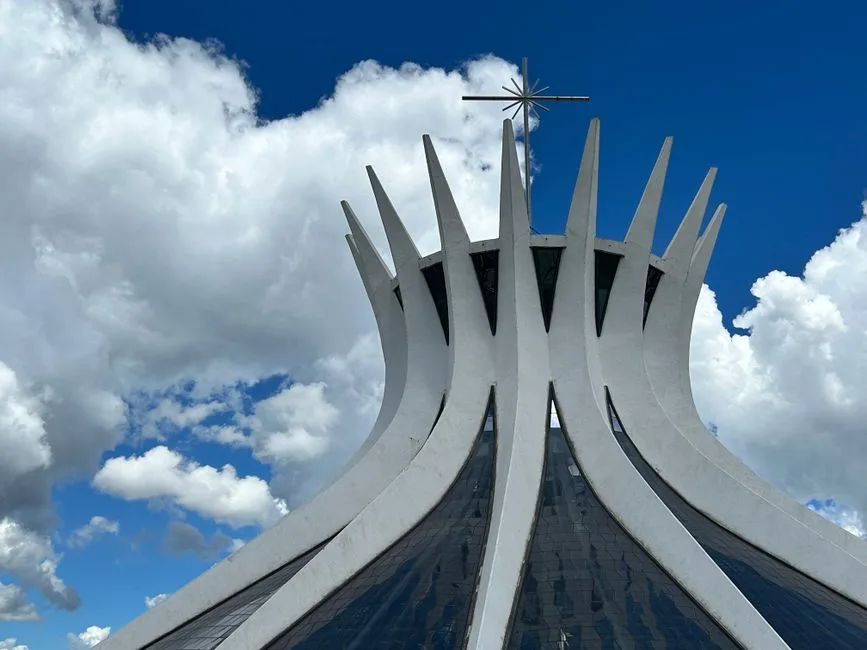
Sunlight slices through the concrete ribs of the cathedral and paints curved shadows on the marble floor. Tourists snap pictures, but if you step between two of those columns and tilt your head, you will hear another sound: the city, for once, not shouting. That hush is Brasília’s trick. It looks like a monument at every scale — public, civic, sculptural — and it rewards the small, curious gestures you make as a pedestrian: a close-up of a draft of light, the seam where glass meets concrete, a bowl inside a grand dome.

One-sentence orientation: what you will actually see
Brasília is an urban model — a one-off, very visible experiment — where a single modernist language was applied to an entire capital city: long horizontal axes, isolated civic buildings that read like stage sets, residential superquadras (the orthogonal apartment blocks with green fingers), and lots of expressive reinforced concrete, carved into curves.
Why that matters to a visitor
Knowing the intent behind the shapes changes how you walk here. The buildings are not just pretty; they were meant to organize power and nationhood, to be legible from a distance and symbolic at close range. You can treat Brasília like a museum of civic ideas, or you can try to feel it as lived-in space. Both approaches reveal details Niemeyer and Lúcio Costa engineered deliberately.
Lúcio Costa, Niemeyer, Burle Marx — who did what
Names matter because Brasília was assembled the way you’d build a machine. The urban plan — the long imprint on the land that looks like an airplane from above — came from Lúcio Costa’s Plano Piloto, the blueprint that organized functions by sector across a strict axis. Oscar Niemeyer then translated certain programmatic elements into buildings: the Congress with its twin towers and domes, the Palácio do Planalto, the hyperboloid cathedral, the Ministry blocks with graceful arcades. Roberto Burle Marx shaped the public gardens, pools, and planted gestures that soften the concrete with native plant palettes.
A few anchor facts
- Brasília was inaugurated as Brazil’s capital on April 21, 1960.
- The core civic area aligns along the Eixo Monumental (Monumental Axis), the city’s ceremonial spine.
- In 1987 UNESCO designated Brasília a World Heritage Site because it’s a rare example of city-scale modernist planning.
Architectural gestures to look for — not just names
Don’t memorize labels; look for moves. Niemeyer used a shorthand of certain formal devices that repeat across civic projects. Spotting those will make every building talk to the next.
- Pilotis: Columns that lift volume off the ground, creating a sense of floating mass and open public space beneath.
- Curved slabs: Sweeping rooflines and cantilevers that suggest motion and organic form, often very thin against the sky.
- Brise-soleil: Concrete sunscreens and screens that cut glare and draw patterned shadows — these are both functional and decorative.
- Free façades: Glass and concrete juxtaposed so the façade becomes a membrane rather than a load-bearing wall.
- Reflecting pools and plazas: Water used sparingly to mirror shapes and to cool the hard surfaces around them.
How the Monumental Axis reads at eye level
Walk the Eixo Monumental like a ritual. From east to west you’ll encounter a procession: large-scale ministries lined like columns; the theater-dome shapes of the National Museum; the twin towers and domes of the National Congress; and, in the Praça dos Três Poderes, the Palácio do Planalto and the Supreme Court’s stern volume. The axis is long and intentionally cinematic: vantage points frame other buildings deliberately, so pause, turn, and look back often. You’ll notice sightlines that were plotted to connect courtyards and plazas visually; those are not accidents.
Practical rhythms: how to tour Brasília without wasting time
Brasília is not a walk-everywhere city in the way European centers are. Distances are long; shade sparse on hot afternoons. But the main architectural cluster is compact enough that a well-planned day will give you depth rather than checklist exhaustion.
One-day route for architecture lovers (walking + short rides)
Start at Praça dos Três Poderes early — the light is sweet and security lines are gentler. From there move north along the Eixo Monumental.
- Praça dos Três Poderes: Stand between the Planalto, the Supreme Court, and the National Congress. Watch how scale and symmetry construct authority.
- Cathedral Metropolitana: Cross to the hyperboloid ribs and step inside. The glass at the crown pours cool light into the nave; the effect is better in the morning.
- Esplanada dos Ministérios: Walk the colonnaded ministry buildings; they read as a classroom in federal identity — each façade subtle, each shadow pattern different.
- Museu Nacional da República: Visit the domed spaces, then cut west toward Itamaraty.
- Itamaraty Palace: The reflecting pools and interior atrium are an excellent contrast to the heavier civic buildings. If available, join a guided interior tour.
End the day at the TV Tower viewpoint or the Feira da Torre to watch local life and try street food. If you time the route right, you’ll catch golden hour on the long facades — the concrete warms to ochre.
Two- and three-day itineraries: room to breathe
With more time, add these layered encounters.
- Day 2: Explore the residential superquadras in Asa Sul and Asa Norte. These sectors were designed as neighborhoods with shops and schools built into the superquadra model. Walk the green fingers, notice the playgrounds, small churches, and local bakeries. People live here; architecture meets daily life.
- Day 3: Head out to the JK Memorial and the Estádio Nacional (Mané Garrincha) for contrast: one memorialized civic act and one contemporary urban infrastructure piece. Finish with a museum or cultural center visit — Brasília’s cultural institutions reinterpret the modernist vocabulary in new media and installations.
Photo tips that come from standing under the sun
Golden hour is unbeatable, of course. But Brasília has a second trick: the midday sun accentuates concrete shadows and reveals form through pure light. If you want sculptural silhouettes, shoot at noon. For warmer tones and softer curves, time your shots for sunrise or sunset.
How to get inside sensitive sites (and what to expect)
Several buildings allow public interior visits, but security is strict. The National Congress offers guided tours that show the plenary halls — you will need ID and you’ll pass through metal detectors. The Palácio do Planalto sometimes opens for guided visits, but those are scheduled and can change with political events. If you want the interior, plan ahead: pick a weekday, carry photo ID, and allow time for security checks.
What the city’s critics get right — and where they miss the point
Critics often call Brasília sterile or hostile to street life. They are right: the superquadras’ internal logic prioritized cars and green pockets over dense street-level commerce, so the city can feel quiet and compartmentalized. That was partly the point: the planners wanted hygienic, orderly urban slices. Where critics miss the point is in assuming a lack of intimacy. The intimacy here exists in different scales — in courtyards, in internal gardens, in the deliberate pauses between buildings. Once you look for those micro-places, Brasília’s design becomes revealing rather than alienating.
Where to eat between photo stops (real-world, day-by-day suggestions)
Food in Brasília runs from small neighborhood cafes in the superquadras to full-service restaurants along the lake. For a mid-morning coffee and pão de queijo, stop at a bakery in Asa Sul. For lunch near the Esplanada, look for small embassies’ staff restaurants or casual bistros around Setor de Gestão Pública. End an architectural day with dinner in the lakefront area (Beira Lake) where you can watch Brasília’s skyline silhouette across the water.
Local rhythms: when to visit and how weather plays with form
The dry season (roughly May through September) gives you crisp skies and excellent visibility — perfect for photographing long sightlines and the city’s topography. The wet season brings dramatic cloudscapes and sudden late-afternoon thunderstorms that can make concrete look cinematic but will complicate walking. Bring sunscreen year-round; shade can be limited on the Monumental Axis.
The small details Niemeyer loved — and you should look for
Niemeyer’s architecture hides small, human-scale delights inside its grand gestures: a narrow bench cured into a wall, a small garden tucked between ministries, a skylight that focuses a single, theatrical beam on a staircase. Look down and look up. The projects were not only sculptural; they were also crafted for moments where a person pauses.
My favorite tiny moments
Once, waiting for a bus at a shaded plaza in Asa Norte, I watched an elderly woman arrange a bouquet of roadside flowers in a plastic cup and then set it beside a low wall that curved like a smile. The wall was Niemeyer’s arc, but the gesture — a woman adding color to that arc — made the architecture belong in a human way I hadn’t expected. Architecture can hum with lives like that if you let it.
Walking distances and a sensible pace
The Eixo Monumental’s main stretch is walkable, but accommodate heat and security checks: a relaxed itinerary that mixes walking with short taxi or ride-share hops will let you see the interiors without overdoing it. Expect to walk 5–7 kilometers if you follow a full-day plan on foot, with stops for museums, coffee, and security queues.
Two practical cautions foreign visitors often miss
- Security and access: Government buildings can close suddenly for official events. If a building looks closed, it often is — not a local snub, just a security decision.
- Scale fatigue: The civic spaces are monumental. Schedule breaks. A two-hour pause in a shaded café will help you appreciate the next round of façades.
Alternative experiences — things you won’t find in guidebooks
Try a dawn visit to the residential superquadras. The bakery ovens open, kids take the school buses, and the communal lawns feel like a neighborhood that the monumental plans never quite captured on paper. Or visit a small community center that runs an exhibition of local artists: Brasília’s contemporary creatives are actively reinterpreting modernist space through murals, installations, and interventions that slide into courtyards and stairwells.
How Brasília’s architecture shapes political theatre
The city’s monumental clarity makes it an exceptional stage for politics. Rallies, speeches, and protests use the axes and plazas because those sightlines make actions legible on camera. That spatial logic is deliberate: the designers imagined a capital whose public rituals would be visible and symbolic. When you stand in the Praça dos Três Poderes, you can almost feel that choreography — buildings designed to bear witness.
Where to stay if architecture is your primary reason
Choose accommodations in Asa Sul or Asa Norte for quiet neighborhood access and short commutes to the Monumental Axis. If you prefer being in the heartbeat of tourist flow and lakefront dining at night, pick a hotel closer to the Beira Lake area. Either way, arrange your mornings for early starts; the best light and calmest streets belong to dawn.
Final practical checklist before you go
- Carry official photo ID for interior tours.
- Book guided visits to the National Congress or Planalto if you want interiors; otherwise expect to admire façades from outside.
- Wear comfortable shoes; bring a hat and water. The concrete reflects heat.
- Check opening times for museums and diplomatic buildings; they close more on public holidays and for official events than regular tourist museums.

A final practical dare
Pick a single building and stare at its joints for twenty minutes. Watch how light draws new lines on concrete; watch people pass and reframe the architecture. That slow gaze is how Brasília starts to stop feeling like a postcard and becomes, instead, a lived experiment — one that rewards curiosity more than speed. Go early, take your time, and plan a coffee break in a superquadra so you can compare the monument to the neighborhood. That comparison will teach you more about the city than any brochure ever will.